A bottle manufacturing machine is industrial equipment used to produce bottles from materials such as PET, HDPE, LDPE, polypropylene, and glass. The exact machinery depends on the bottle material, shape, size, production method, and intended application. Plastic bottle manufacturing machines are widely associated with packaging because bottles provide a practical way to contain liquids, powders, and other products.
Bottle production has developed alongside modern packaging. Early containers were shaped largely by manual methods, while industrial production introduced mechanical forming, heating, molding, and automated handling. Today, different bottle manufacturing machine designs can produce containers with consistent dimensions and shapes.
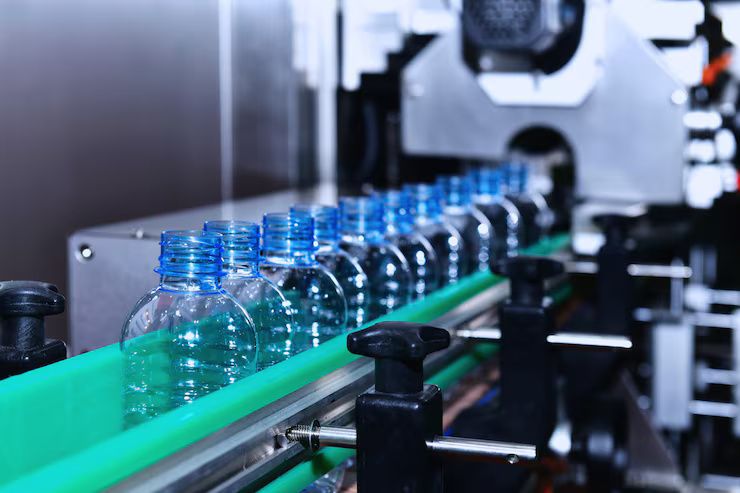
For plastic bottles, the manufacturing process commonly begins with plastic pellets or preforms. The material is heated until it becomes suitable for forming, then shaped inside a mold. Glass bottle production follows a different route, using molten glass that is formed through specialized molding equipment.
What a Bottle Manufacturing Machine Does
The main purpose of a bottle manufacturing machine is to transform a raw material or intermediate form into a finished bottle. Depending on the equipment, the system may also include feeding, heating, molding, cooling, trimming, inspection, and material handling.
A complete production setup can contain several connected machines rather than one standalone unit. Each stage has a specific function, and the arrangement depends on the bottle design and material.
Common Bottle Materials
Different materials provide different characteristics. Common options include:
- PET: Frequently used for beverage containers and various lightweight packaging formats.
- HDPE: Used for containers that require greater rigidity and resistance to impact.
- LDPE: Suitable for flexible bottles and containers that can be squeezed.
- Polypropylene: Used for selected packaging applications where its material properties are suitable.
- Glass: Used where a rigid, reusable, or heat-resistant container is required.
The material selected affects the molding process, heating requirements, equipment configuration, and final bottle properties.
Importance
Bottle manufacturing is important because containers are used across food and beverage packaging, household products, personal care, chemicals, pharmaceuticals, and industrial applications. The production process needs to balance shape, strength, weight, dimensional accuracy, and material use.
For everyday users, the quality of a bottle affects how easily it can be transported, opened, stored, and handled. For manufacturers, consistent bottle dimensions are important because bottles often need to work with caps, labels, filling equipment, conveyors, and other packaging machinery.
Why Machine Selection Matters
Different bottle designs require different forming methods. A machine designed for PET stretch blow molding is not necessarily suitable for producing a rigid HDPE container through extrusion blow molding.
Important considerations include:
- Bottle material
- Container volume
- Neck size and design
- Bottle shape
- Wall thickness
- Production volume
- Mold configuration
- Heating method
- Cooling requirements
- Automation level
- Required inspection processes
A small bottle with a simple shape may require a very different production setup from a large industrial container.
Practical Example
Consider a PET beverage bottle. A PET preform is first produced or supplied as an intermediate component. The preform is reheated and placed inside a bottle mold. Air pressure then expands the softened material against the mold walls, creating the final bottle shape.
This process explains why bottle production involves more than simply placing plastic into a mold. Heating, stretching, air pressure, cooling, and mold design all influence the final container.
Recent Updates
Bottle manufacturing technology has continued to evolve from 2024 through 2026, with greater attention on material efficiency, automation, energy management, recycled materials, and process monitoring.
One noticeable trend is the increased use of recycled plastic feedstock where material specifications and application requirements allow it. PET bottles, for example, can incorporate recycled PET in suitable production systems. Material preparation and quality control become particularly important when recycled feedstock is introduced.
Automation and Digital Monitoring
Modern bottle manufacturing systems increasingly use sensors and digital controls to monitor production conditions. Temperature, pressure, cycle timing, material flow, and other parameters can be tracked during operation.
Automated inspection systems are also being used to identify issues such as:
- Incorrect bottle dimensions
- Deformation
- Surface defects
- Inconsistent wall thickness
- Contamination
- Improper neck formation
These technologies help operators identify variations during production rather than relying only on manual inspection.
Lightweight Bottle Design
Another continuing development is lightweighting. This involves designing containers that use less material while maintaining the properties required for their intended application.
Lightweighting requires careful control of wall thickness and bottle geometry. Reducing material without considering structural requirements can affect bottle performance, so the design and manufacturing process need to be evaluated together.
Laws or Policies
Bottle manufacturing is influenced by environmental, packaging, workplace, material, and product-safety regulations that vary between jurisdictions. Although the specific requirements differ, several regulatory themes appear across many markets.
Packaging regulations may address the materials used in containers, labeling, recycling, recycled content, waste management, and producer responsibilities. Environmental rules can also cover emissions, industrial waste, water use, and disposal of manufacturing residues.
Packaging and Recycling Requirements
Plastic bottle production is increasingly connected with circular-economy policies. These policies may encourage recycling, collection, recycled material use, or improved packaging design.
Extended Producer Responsibility, commonly known as EPR, is one approach used in various jurisdictions. Under such systems, organizations involved with packaging may have defined responsibilities related to collection, recovery, recycling, reporting, or financing of waste-management activities.
Manufacturing Compliance
A bottle manufacturing facility may also need to consider requirements related to:
- Workplace safety
- Machine guarding
- Electrical safety
- Industrial emissions
- Wastewater management
- Material handling
- Product-contact materials
- Packaging labeling
- Waste segregation and recycling
The exact requirements depend on the location, material, industry, and intended use of the bottle. Regulatory requirements should therefore be checked against the rules applicable to the specific production operation.
Tools and Resources
Several technical resources can help readers understand bottle manufacturing machines and production processes. Machine manuals and technical datasheets can explain operating ranges, mold dimensions, heating systems, cycle characteristics, and material compatibility.
Material datasheets are useful when comparing PET, HDPE, PP, and other polymers. They typically provide information about density, thermal behavior, mechanical properties, and recommended processing conditions.
Useful Planning Resources
Common resources used when studying bottle manufacturing include:
- Material property datasheets
- Mold design references
- Bottle design software
- Production planning spreadsheets
- Energy monitoring tools
- Quality inspection checklists
- Preventive maintenance schedules
- Packaging specifications
- Recycling and material identification guides
A basic production assessment can also compare machine characteristics before a manufacturing system is configured.
| Factor | Relevance to Bottle Production |
|---|---|
| Bottle material | Determines the appropriate forming process |
| Bottle volume | Influences mold and machine configuration |
| Neck design | Affects preform, mold, and closure compatibility |
| Wall thickness | Influences strength and material usage |
| Mold cavities | Determines how many bottles can be formed per cycle |
| Heating system | Prepares plastic for forming |
| Cooling system | Helps stabilize the molded bottle |
| Automation | Influences feeding, handling, inspection, and process control |
Main Types of Bottle Manufacturing Machines
The term bottle manufacturing machine covers several types of equipment. The most suitable type depends primarily on the material and forming method.
PET Blow Molding Machine
PET blow molding machines are commonly used to produce lightweight containers. In many processes, PET preforms are heated and then expanded inside molds using compressed air.
Stretch blow molding can stretch the preform both lengthwise and outward. This creates the final bottle shape and can provide the material orientation required for particular applications.
Extrusion Blow Molding Machine
Extrusion blow molding is commonly used with materials such as HDPE and other thermoplastics. A heated plastic tube, known as a parison, is placed between mold sections. The mold closes around it, and air pressure pushes the plastic against the mold surface.
This process is used for many rigid containers, including bottles with handles or complex shapes.
Injection Blow Molding Machine
Injection blow molding combines injection molding and blow molding in a connected process. A preform is first created around a core, transferred to a blow mold, and then expanded into the final container.
This method can provide accurate control over the preform and bottle geometry.
Injection Stretch Blow Molding Machine
Injection stretch blow molding is widely associated with PET container production. The preform is stretched mechanically and expanded with air inside a mold.
The process is suitable for bottles where lightweight construction, transparency, and controlled dimensions are important.
Bottle Manufacturing Process
Although the exact sequence varies, plastic bottle production commonly follows several stages.
Material Preparation
Plastic resin or preforms are prepared for processing. Recycled material may also be incorporated when the production system and product requirements permit it.
Heating
For processes using preforms, the material is heated to a controlled temperature range that makes it suitable for stretching and forming.
Molding
The heated material enters or remains within a mold. Mechanical movement and compressed air, depending on the process, shape the material against the mold walls.
Cooling
The formed bottle is cooled so that it can maintain its intended shape after leaving the mold.
Inspection and Handling
Finished bottles may pass through inspection systems that check dimensions, appearance, weight, and other defined characteristics. They can then move to storage, filling, labeling, or another packaging stage.
Applications
Bottle manufacturing machines are used to produce containers for many applications.
Common areas include:
- Beverage containers
- Food packaging
- Household products
- Personal care products
- Agricultural containers
- Industrial chemicals
- Automotive fluids
- Medical and laboratory packaging
- Cleaning products
The required bottle design varies significantly between applications. A beverage container may emphasize lightweight construction and controlled dimensions, while an industrial container may require greater rigidity and resistance to handling conditions.
FAQs
What is a bottle manufacturing machine?
A bottle manufacturing machine is equipment used to form bottles from plastic, glass, or another suitable material. Plastic systems may use injection molding, extrusion blow molding, or stretch blow molding depending on the container design.
How does a plastic bottle manufacturing machine work?
A plastic bottle manufacturing machine generally heats or melts plastic and forms it using a mold. In blow molding, air pressure expands the softened material against the mold surface before the bottle is cooled and removed.
What are the main types of bottle manufacturing machines?
Common types include PET blow molding machines, extrusion blow molding machines, injection blow molding machines, and injection stretch blow molding machines. Each uses a different forming process and is suited to particular materials and container designs.
Which materials can bottle manufacturing machines process?
Depending on the machine, materials can include PET, HDPE, LDPE, polypropylene, and other thermoplastics. Glass bottles require specialized glass-forming equipment rather than plastic molding machinery.
What factors affect bottle manufacturing?
Bottle material, container shape, volume, neck design, wall thickness, mold configuration, heating, cooling, and production conditions all influence the manufacturing process. The intended application also affects the required bottle characteristics.
Conclusion
Bottle manufacturing machines use different forming technologies to convert plastic, glass, or other materials into containers with defined shapes and dimensions. PET blow molding, extrusion blow molding, injection blow molding, and injection stretch blow molding are among the main processes used for plastic bottles. Recent developments have placed greater attention on automation, recycled materials, lightweighting, digital monitoring, and resource efficiency. Regulations related to packaging, recycling, environmental protection, and workplace safety also influence how bottle manufacturing operations are designed and managed.